
Strain Rate Sensitivity: Why Testing Speed Changes Material Behavior
When we talk about material strength, stiffness, or ductility, it’s tempting to think of these as fixed properties — constants that define how a material behaves. But materials aren’t static; they respond to their environment and, importantly, to the speed at which they are loaded.
Picture two identical specimens of aluminum alloy. In one test, the machine stretches it slowly over several minutes. In another, the same machine pulls it to the same extension in just a fraction of a second. The result? Two very different stress–strain curves, two different failure modes, and possibly two very different conclusions about the material’s “strength.”
This is the essence of strain rate sensitivity — the way mechanical properties change with loading speed. And in many applications, from crash safety to high-speed forming, ignoring it can be costly.
What Is Strain Rate Sensitivity?
In materials testing, strain rate is simply the speed of deformation. Low strain rates mean the material deforms slowly, such as in creep or slow tensile tests. High strain rates mean it’s loaded very quickly, such as in an impact or crash simulation.
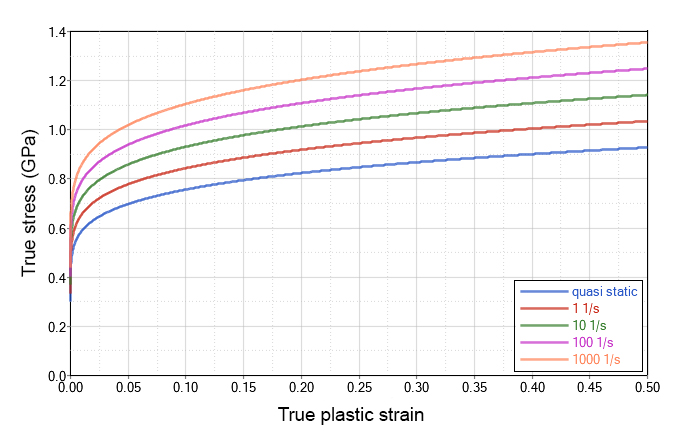
What makes strain rate sensitivity so important is that a material’s yield strength, tensile strength, elongation, and even its fracture mode can shift dramatically with changes in strain rate.
Metals like steel and aluminum may become stronger but lose ductility. Polymers can flip from ductile to brittle behavior. Composites might switch from progressive failure to catastrophic breakage.
In short, the speed of the test can rewrite the story of how a material fails.
Why Does It Matter?
Design engineers don’t work in a vacuum. The real world doesn’t load materials at a single, constant rate. A car chassis might experience both slow, sustained stresses and instantaneous impact forces in its lifetime. A manufacturing line might deform metal slowly during forming but subject it to sudden accelerations during handling.
If testing ignores the appropriate strain rate:
- Safety margins might be based on unrealistic performance.
- Critical failure modes could be missed entirely.
- Standards compliance could be compromised.
Understanding strain rate sensitivity ensures that test results truly reflect how materials will behave in service.
Measuring Strain Rate Sensitivity
The most common way to quantify strain rate sensitivity is with the strain rate sensitivity index (m):
m = log( σ2 / σ1 ) / log( ε̇2 / ε̇1 )
Where:
- σ1, σ2 – flow stresses measured at two different strain rates
- ε̇1, ε̇2 – the corresponding strain rates
This index compares flow stresses at different strain rates. A near-zero m means the material is largely insensitive to rate; a higher m means its properties vary significantly with speed.
In practice:
- Test specimens at multiple controlled strain rates.
- Measure flow stress at a fixed plastic strain (often 0.2% offset).
- Plot stress vs. strain rate on a log–log scale.
- The slope of the line gives m.
For example, an m value of 0.05 might be acceptable for structural steel at room temperature, while certain polymers could show m values above 0.1, indicating much stronger rate dependence.
Real-World Examples
When a polymer bumper component is tested slowly, it may stretch and absorb energy before breaking — ideal for energy dissipation. The same component tested at a high strain rate might shatter with almost no warning.
A carbon fiber panel under slow tensile load may show gradual delamination and fiber pull-out. Under a sudden load, it can fail catastrophically, with little chance for the operator to react.
Even mild steel — often considered “predictable” — can see noticeable increases in yield stress at higher strain rates, which is why automotive crashworthiness simulations often use high-rate tensile data.
Controlling Strain Rate in Testing
Modern servo-hydraulic and electromechanical test systems allow very precise strain rate control through closed-loop feedback. That means an engineer can replicate real-world scenarios — whether that’s a slow creep-like load or a split-second impact.
Best practice is to:
- Match the strain rate to the intended application.
- Use sensors with fast enough response to capture high-rate events.
- Follow relevant ASTM or ISO standards for consistency.
Conclusion
Strain rate sensitivity isn’t just a lab curiosity — it’s a design and safety necessity. The loading speed during testing can dramatically alter conclusions about how strong, stiff, or safe a material is.
By carefully selecting test speeds, measuring the strain rate sensitivity index, and interpreting results in the context of real-world application, engineers can create safer designs, reduce unexpected failures, and produce data that truly reflects material performance.
Share this post: