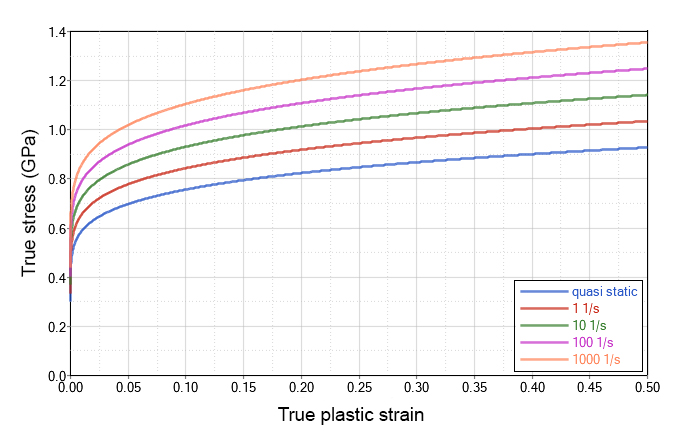
When we talk about material strength, stiffness, or ductility, it’s tempting to think of these as fixed properties — constants that define how a material behaves. But materials aren’t static; they respond to their environment and, importantly, to the speed at which they are loaded.
Picture two identical specimens of aluminum alloy. In one test, the machine stretches it slowly over several minutes. In another, the same machine pulls it to the same extension in just a fraction of a second. The result? Two very different stress–strain curves, two different failure modes, and possibly two very different conclusions about the material’s “strength.”
This is the essence of strain rate sensitivity — the way mechanical properties change with loading speed. And in many applications, from crash safety to high-speed forming, ignoring it can be costly.