
A deep dive into the custom hardware, edge logic, and cloud platform powering the next generation of machinery.
In an era where industrial machines must be smarter, faster, and more autonomous, TACTUN is rethinking how control systems are designed and deployed. At the heart of this transformation is a full-stack platform — spanning from a custom-built hardware controller to a cloud-based deployment environment and application builder.
This post takes you under the hood of TACTUN’s technology, breaking down how we build the “brain” for smart machinery.
The TACTUN platform is built around a unified architecture composed of two deeply integrated parts:
A custom embedded controller, designed per customer, and
A cloud-powered software platform, enabling no-code product design, application generation, and remote updates.
Together, these components replace traditional general-purpose controllers, modular PAC systems, and standalone HMI software with a single, tightly coupled stack — optimized for control, intelligence, and scale.
At the machine level, TACTUN’s controller operates as the real-time decision-making unit, doing data acquisition, close-loop control, running deterministic logic, and motion control on-device. At the user level, engineers and machine builders interact through a software environment to define logic, generate desktop apps, and manage their fleet — all without writing code.
TACTUN starts with a fully custom controller tailored to each customer’s I/O and control needs. Unlike traditional modular PLCs or PACs, our architecture eliminates overhead by embedding everything on a single PCB.
Each controller features:
These capabilities are critical for machines that demand precision, speed, and tight control loops — especially in sectors like materials testing, motion control, or robotics.
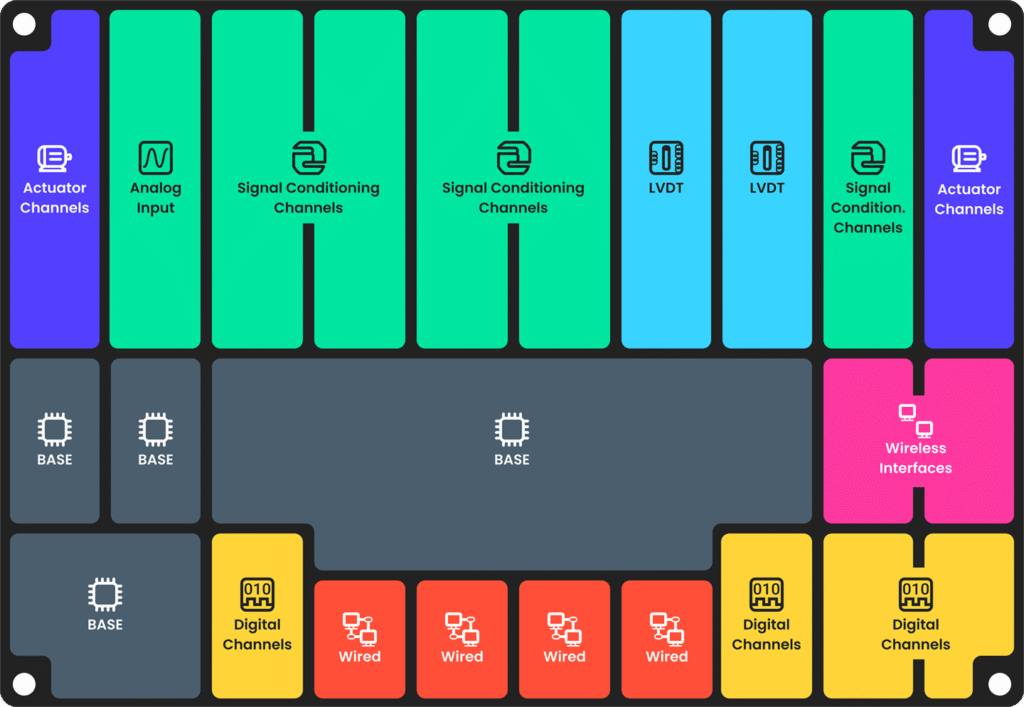
The FPGA executes high-deterministic/critical tasks like PID loops, signal filtering, safety checks, and time-critical control patterns. Logic is implemented at the hardware level, ensuring minimal latency and zero reliance on operating systems.
The result: minimal latency, ultra-high precision, and full adaptability delivered at scale, with zero NRE fees and a repeatable design per customer.
Looking forward, TACTUN is introducing a new class of controllers with onboard AI Compute power. This enables custom AI-model inference, Custom deployments of VLM and VLAM — right at the edge, without cloud dependency. The first model of controller will be based on NVIDIA technology.
TACTUN’s no-code platform runs entirely in the cloud and serves as the “development” environment for machinery builders.
Using the platform engineers can:
Once the product design is finalized, the platform provides a one-click build process, which compiles everything into a standalone Windows installer — the machine’s end-user interface. This build process runs entirely in the cloud, allowing machine builders to generate multiple apps for different customers and machine models or versions without needing any software development tools.
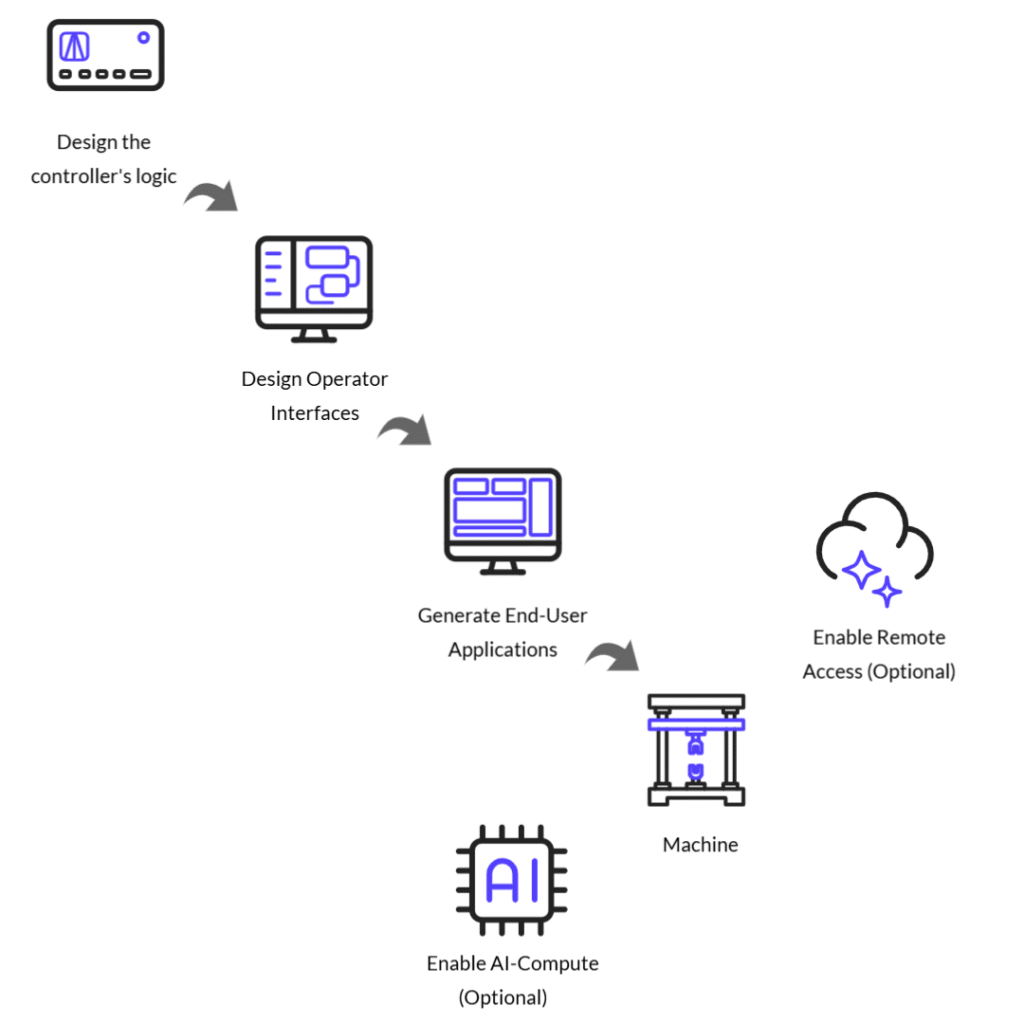
The output of the cloud-based platform is a white-labeled standalone Windows desktop application, tailored to the exact configuration created by the machine builder, linked to the exact controller. This app is designed for use by the end customer — typically the machine operator — and does not require internet access, cloud connectivity, or a runtime environment.
Once installed on a PC, the application communicates directly with the TACTUN controller over Ethernet. It automatically detects the controller and loads the appropriate logic, allowing the operator to interact with the machine using an intuitive interface.
The application is white-labeled with the manufacturer’s branding and can include:
What makes this application powerful is its flexibility. Every feature, control logic, and interface element is defined by the machine builder during the product design process.
Additionally, user permissions can be configured within the build process. This allows the builder to define distinct access levels for different end-user roles — for example, restricting access to calibration or setup screens, while providing operators with a simplified view focused only on essential controls.
The result is a clean, purpose-built application, fully aligned with the machine’s logic and brand, and ready for deployment in production environments — no custom development, no integration effort.
At TACTUN, we believe the future of machinery is autonomous. That future demands a new way of Research and Development, such that does not require programming skills. You can call it Vibe coding for machinery. This also requires a new kind of “brain” —controller, one that blends real-time control, cloud flexibility, and human-friendly tools.
If you’re building machines that need to think, sense, and act with precision, we invite you to build with us.
Share this post:
TACTUN Inc uses third-party cookies for analytical and personalization purposes, as well as to show you advertising related to your preferences based on your browsing habits. You can accept all cookies by selecting the "Accept" option. You can also set and/or refuse the installation of cookies by selecting "Cookie settings" option. You can find more information in our Cookie Policy.

